There is often an invisible gap between the people standing at the edge of a nickel mine, documenting deforestation and land conflicts firsthand, and those assessing investment risks based on the information that reaches their desks, if it reaches them at all. This is the gap that the workshop “Closing the Gap: From Field Evidence to Investor Engagement” sought to narrow. One of the ways is by focusing on Double Materiality.
INTRA Institute, the knowledge generator of Angin Dampak Jaya (previously ANGIN Advisory), together with Yayasan Kompas Peduli Hutan (KOMIU), with support from the Ford Foundation, organized the workshop, which connects impact investing practices with on-the-ground needs. Held online in two sessions on Wednesday (17 June) and Monday (22 June), the workshop focused on a specific challenge in Indonesia’s critical minerals sector: civil society organizations (CSOs) often possess strong field evidence but do not always know how to present it in a form that investors can act upon.
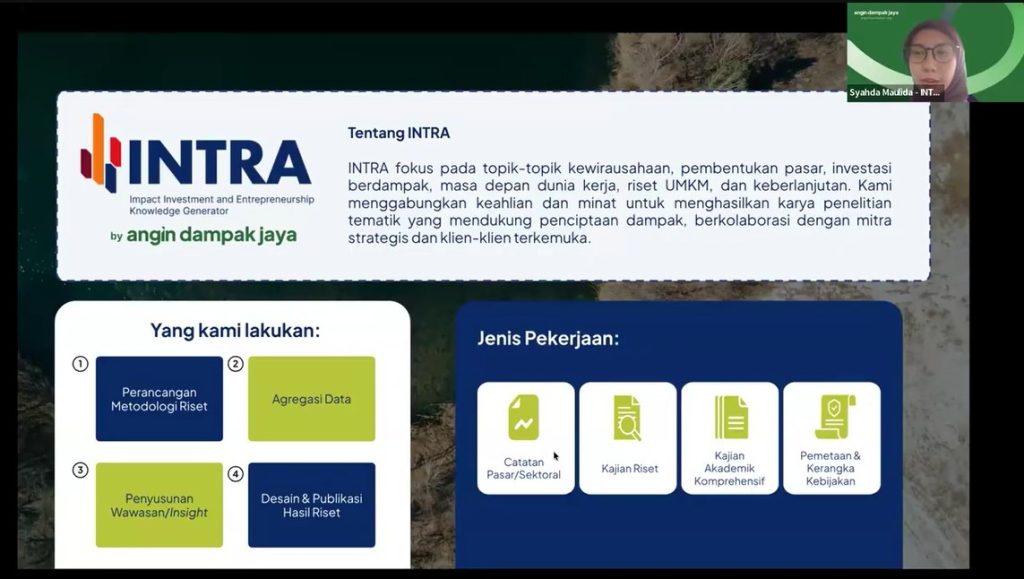
This challenge is not merely an assumption, but a finding from INTRA’s research titled A Preliminary Look into Investor Confidence and ESG in Indonesia’s Electric Vehicle (EV) Sector. The study found that investors care about ESG in the critical minerals sector, paying considerable attention to environmental, social, and governance issues tied to where their capital ends up.
Syahda Maulida, Lead of INTRA and Advisory Associate at Angin Dampak Jaya, stated that one term consistently emerged throughout the research process: stewardship, or active ownership.
“These investors want to be active investors and active asset owners. One way to achieve that is by obtaining credible data and reports from the field. They need this information to assess the ownership risks associated with the companies they invest in,” Syahda said.
Why Investors Need Eyes on the Ground
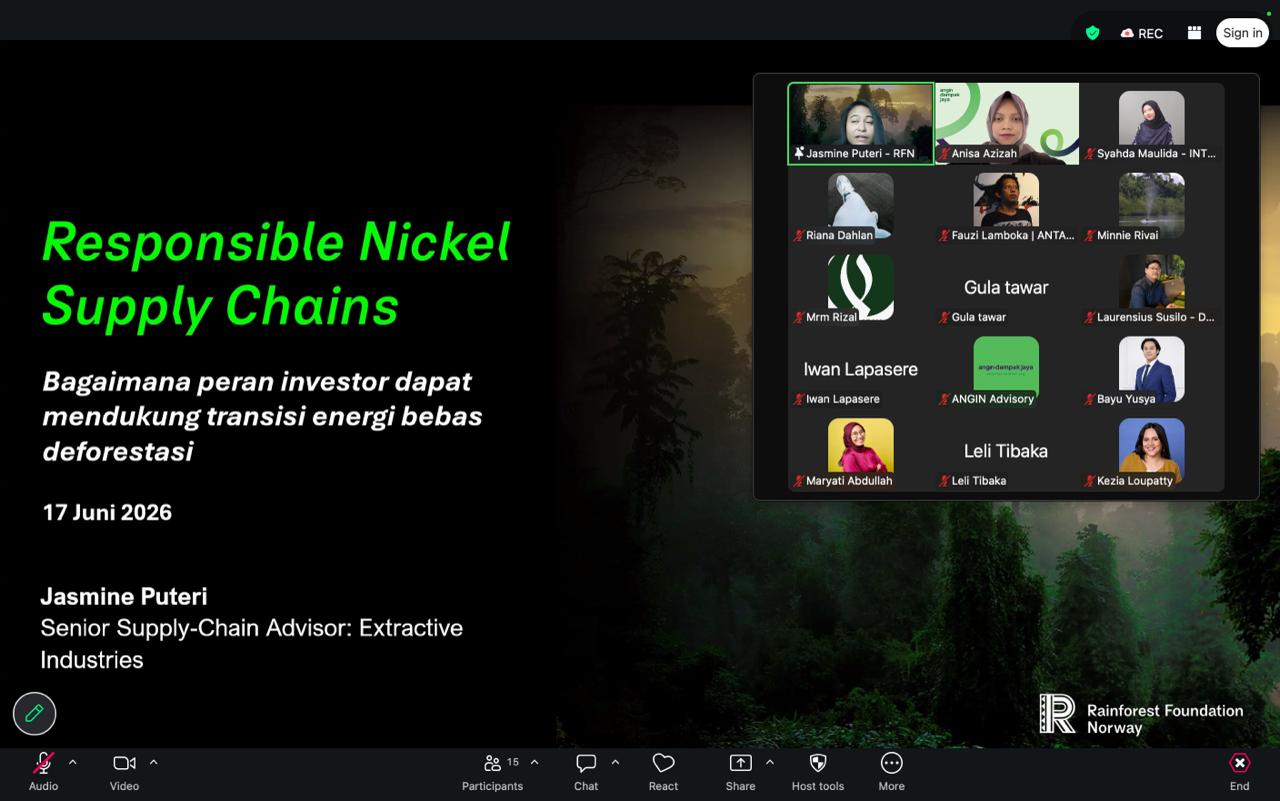
During the first session, Jasmine Puteri, Senior Supply Chain Advisor at Rainforest Foundation Norway (RFN), explained that investors are often far removed from what actually happens throughout the supply chain. That distance makes reputational risk one of their greatest concerns. Once their name becomes associated with environmental destruction or large-scale social conflicts, investors can quickly be perceived as falling short of responsible investment, regardless of how directly involved they actually are.
This is where CSOs hold greater leverage than they often realize. They have access to the realities on the ground, something that is difficult for investors to obtain because supply chains are long and layered.
“Investors are quite far removed from conditions on the ground and operate within long supply chains. That is why connectivity with parties that have access to field-level information is an important necessity,” Jasmine said.
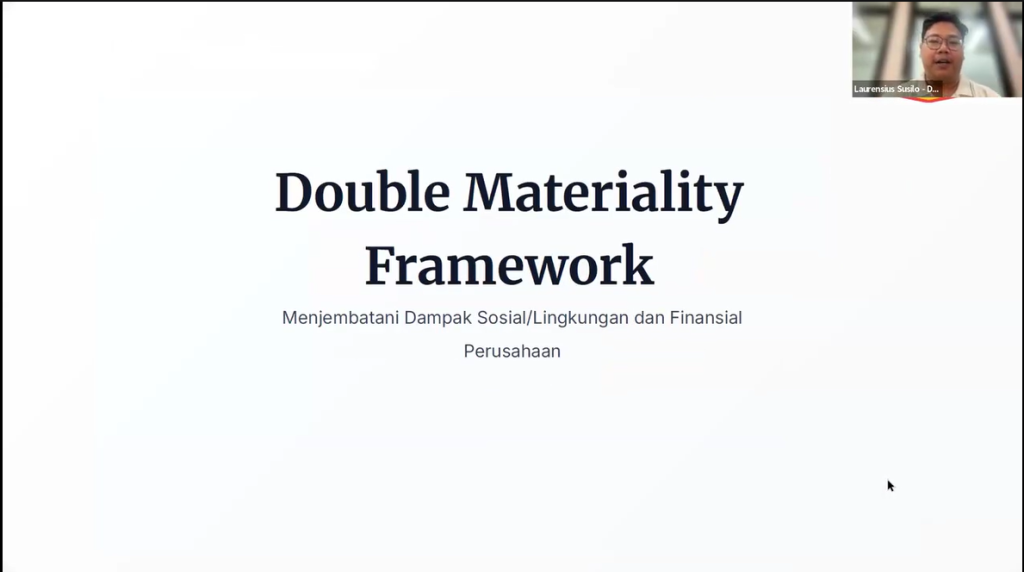
The discussion then progressed to one of the workshop’s central frameworks: double materiality. Laurensius Susilo Yunior, a researcher from the Djokosoetono Research Center at the University of Indonesia (DRC-UI) explained what double materiality is and how it helps connect two dimensions that are often discussed separately, such as the impact of business activities on the environment and society on one hand, and how those impacts ultimately affect a company’s financial condition on the other.
“Double materiality is a framework that serves as a bridge showing that these two aspects influence one another. That is why it is important to examine the available data through the lens of double materiality,” he said.
Double Materiality: A Shared Language for CSOs and Investors
For years, environmental and financial issues were treated as separate domains. Before 2015, sustainability impacts were mainly reported through the Global Reporting Initiative (GRI), while financial reporting followed its own framework under the Sustainability Accounting Standards Board (SASB), with little connection between the two.
This began to change after the Paris Agreement in 2015 elevated sustainability on the global agenda, followed by the European Union’s Corporate Sustainability Reporting Directive (CSRD) in 2022 and the adoption of the European Sustainability Reporting Standards (ESRS) in 2023 as mandatory reporting standards for companies in Europe.
Double materiality emerged to bridge these perspectives by assessing a company’s ESG profile from two directions. Impact materiality examines how a company’s activities affect people and the environment (inside-out), while financial materiality evaluates how external sustainability issues, such as climate change or social crises, create financial risks for the company (outside-in).
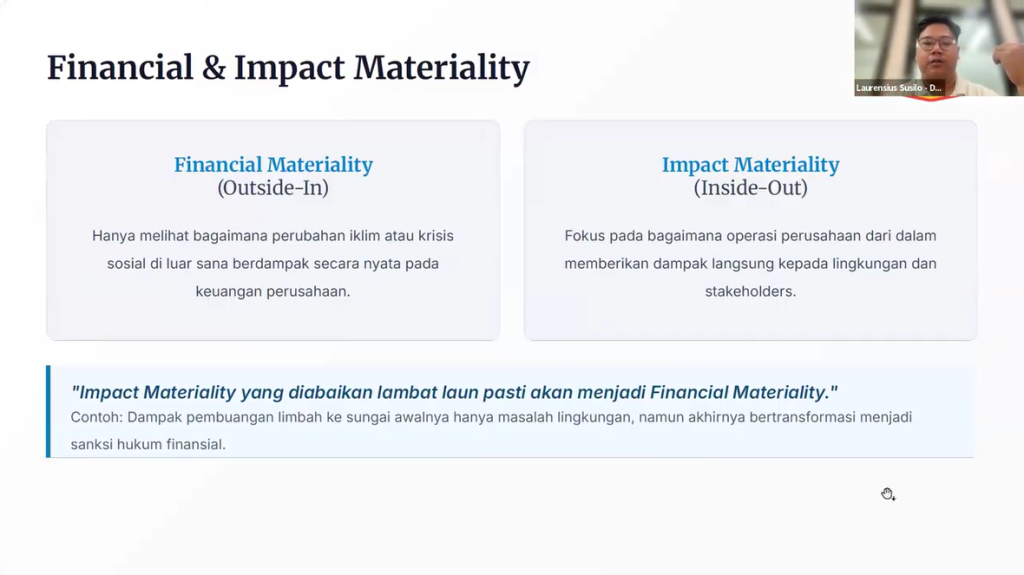
Importantly, these two dimensions are interconnected. A double materiality example often cited is waste discharged into a river, which may begin as an environmental issue but later lead to legal penalties, financial losses, or reduced access to capital. Ignoring impact materiality does not eliminate financial risk; it simply postpones its consequences.
This is why double materiality is highly relevant for CSOs. While CSOs typically focus on environmental, social, and human rights impacts, investors prioritize financial risk, returns, and governance. The double materiality framework provides a shared language between these perspectives through the ten ESRS standards covering environmental, social, and governance issues.
For CSOs, it also strengthens advocacy by encouraging reports that combine empirical evidence, relevant standards, potential financial implications if issues remain unresolved, and practical recommendations for investors.
Translating Local Evidence for Investors with Double Materiality
The second session shifted the discussion from concepts to practice by exploring how field data can be translated into reports that are relevant to investors. Yosi Amelia, Climate and Ecosystem Program Lead at MADANI Berkelanjutan, emphasized that reports attracting media attention do not always meet investors’ needs.
“The materials used for investor briefings need to include data that can illustrate financial risks in measurable terms. For spatial data, for example, the location and its legal status must be clearly identified because they are linked to ESG indicators,” she explained.
She also highlighted that NGO reports often stop at social and environmental issues.
“Reports published by NGOs generally focus more on social and environmental aspects. However, investors also need valuation perspectives, financial implications, and relevant analysis. Therefore, broader collaboration with parties that have the necessary expertise is needed,” she said.
According to her, CSOs do not have to bridge this gap alone. Partnerships with universities, economists, or analysts can help strengthen reports with financial perspectives, as demonstrated by her organization’s experience.
A more personal perspective came from Dhany Alfalah, Campaign Officer at Satya Bumi, who shared how his organization initiates communication with investors.
“Before entering more in-depth discussions with investors, we usually prepare a brief of one to two pages. The document helps investors identify the issues they need to explore further during the discussion process,” he said.
However, Dhany emphasized one aspect that he believes is often overlooked: ensuring that local communities are prepared before advocacy efforts and dialogue with investors begin.
“The most important thing is to ensure that local communities are ready to go through the advocacy process. They are the ones who interact directly with the company and are most likely to face the greatest risks and pressures,” he said.
A Gap That Still Exists in Indonesia
Indonesia’s regulatory landscape is still evolving. The government is drafting a Presidential Regulation on Human Rights Due Diligence, while Financial Services Authority Regulation (POJK) No. 51/2017 requires sustainability reporting but does not specify detailed reporting standards. To date, the application of double materiality in Sustainability Reports in Indonesia remains rare, as noted by Laurensius Susilo Yunior of DRC-UI.
Against this backdrop, the workshop sought to address an important gap by introducing a framework that remains largely absent from Indonesia’s reporting landscape. The need is particularly relevant for the country’s nickel mining sector, where rapid industrial growth coincides with mounting environmental and social challenges.
As the global energy transition accelerates, investors are paying closer attention to ESG performance across the electric vehicle supply chain, with media coverage and CSO reports becoming key sources of information. The workshop therefore brought together CSOs working on environmental, social, labor, and governance issues to explore how field evidence can be translated into information that investors can better understand.
Participants learned to apply the double materiality framework, prepare investor-relevant reports, and connect with global NGO networks that engage international investors. As a follow-up, they were encouraged to produce articles for review by national NGOs, helping them build the capacity to independently publish reports for both national and global audiences.
The evidence from the field has long existed. What has often been missing is a bridge to the tables where investment decisions are made. Double materiality provides that bridge by giving CSOs and investors a shared language for understanding sustainability risks.