
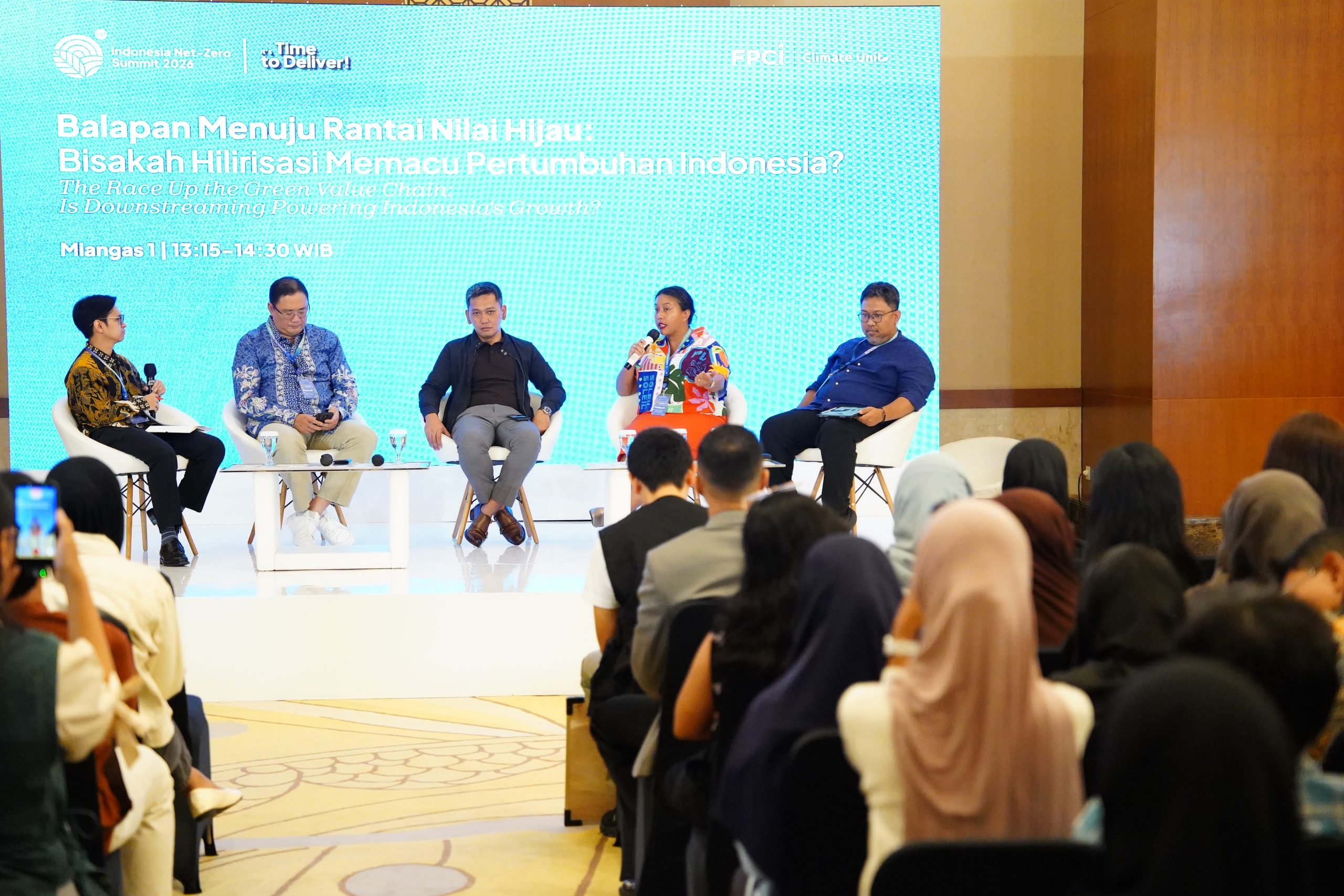
Industrial downstreaming alone will not transform Indonesia’s economy beyond extraction. What matters is what is built around it: the industrial ecosystem, the quality of human capital, and those involved in shaping policies. This was the message delivered by Saskia Tjokro, director of Angin Dampak Jaya (previously Angin Advisory), at the Indonesia Net-Zero Summit (INZS 2026) on Saturday, August 1, 2026, at Balai Kartini in Jakarta.
At the fifth edition of INZS, Indonesia’s largest independent climate forum, Angin Dampak Jaya (ADJ) partnered with the summit through two tracks. Saskia Tjokro represented ADJ as a knowledge partner in a panel discussion on downstreaming and critical minerals. As a program partner, ADJ’s research unit, INTRA Institute, hosted a side event titled “The Melting Pot,” which focused on the bioeconomy and a just transition. Together, these two tracks formed a continuous discussion, from identifying key challenges to exploring solutions collaboratively.
INZS 2026: Why Downstreaming Alone Is Not Enough
Saskia took part in one of INZS 2026’s panel discussions, “The Race Up the Green Value Chain: Is Downstreaming Powering Indonesia’s Growth?”, alongside Fransiscus Soerjopranoto (Chief Operating Officer of PT Hyundai Motors Indonesia), Agung Budiono (Executive Director of CERAH), and Putra Adhiguna (Director of Energy Shift Indonesia). The discussion centered on a key question: Is downstreaming truly transforming Indonesia’s position in the global value chain, or is it merely shifting extractive activities to the next stage?
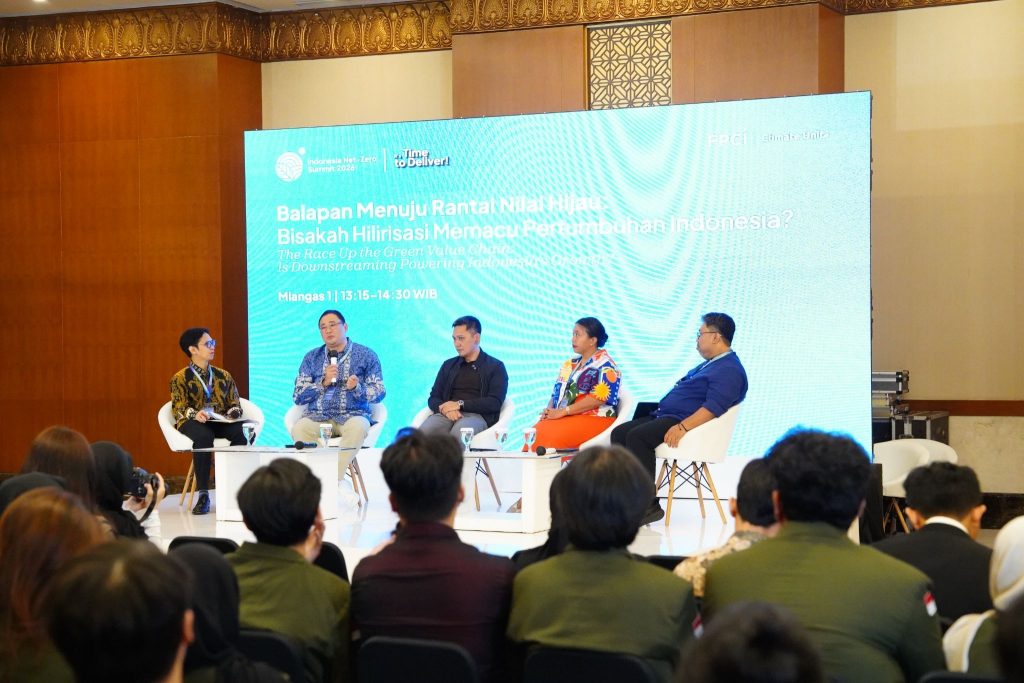
Frans opened with a shift he has seen firsthand as an investor: the old way of sizing up a country by its population and vehicle ownership numbers, he said, has stopped being the main thing global capital looks for.
“What global players look at now is whether an industrial ecosystem actually exists. It’s the same logic behind EV adoption. The first obstacle was always infrastructure, and once that’s there, the ecosystem forms around it. Manufacturing works the same way, from production all the way down to recycling,” Frans said.
That is the exact gap Saskia argued Weda Bay has managed to fill, which is why the site has become a reference point far beyond Indonesia.
“When we talk about Weda Bay, our colleagues in Ghana, Uganda, and Colombia are actually looking to Indonesia. They want to know how Indonesia has managed to attract this level of investment,” Saskia said.
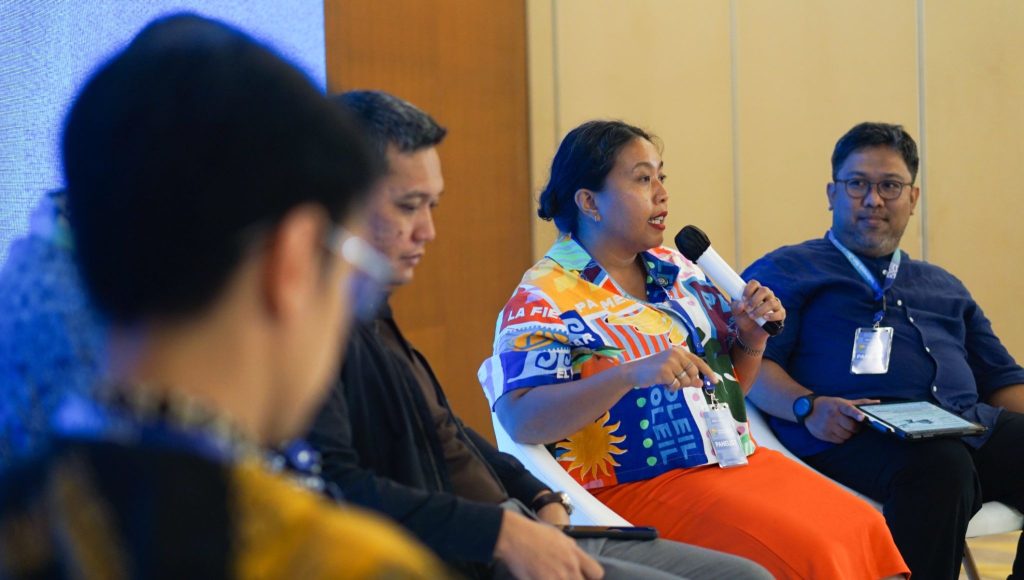
However, she cautioned that the growth of an industrial ecosystem always comes with trade-offs that must be carefully considered.
“Unfortunately, every growing ecosystem comes with a price. The question is what that price means for local communities and the environment,” she continued.
According to her, this is also why impact investors do not focus solely on financial returns. Measuring that impact, however, is not straightforward, and Saskia pointed to the Human Development Index as one metric worth closer attention.
“When we talk about what prosperity actually means for Indonesian society, we’re talking about basic impacts like GDP and regional GDP[…]. But the Human Development Index is actually one important metric to look at, because it’s an aggregation of many other numbers.”
From there, she brought the conversation back to how investors actually apply it. Impact investors remain profit-oriented at their core, but they also set specific impact goals for their investments, such as increasing employment opportunities or maintaining a strong workplace safety record.
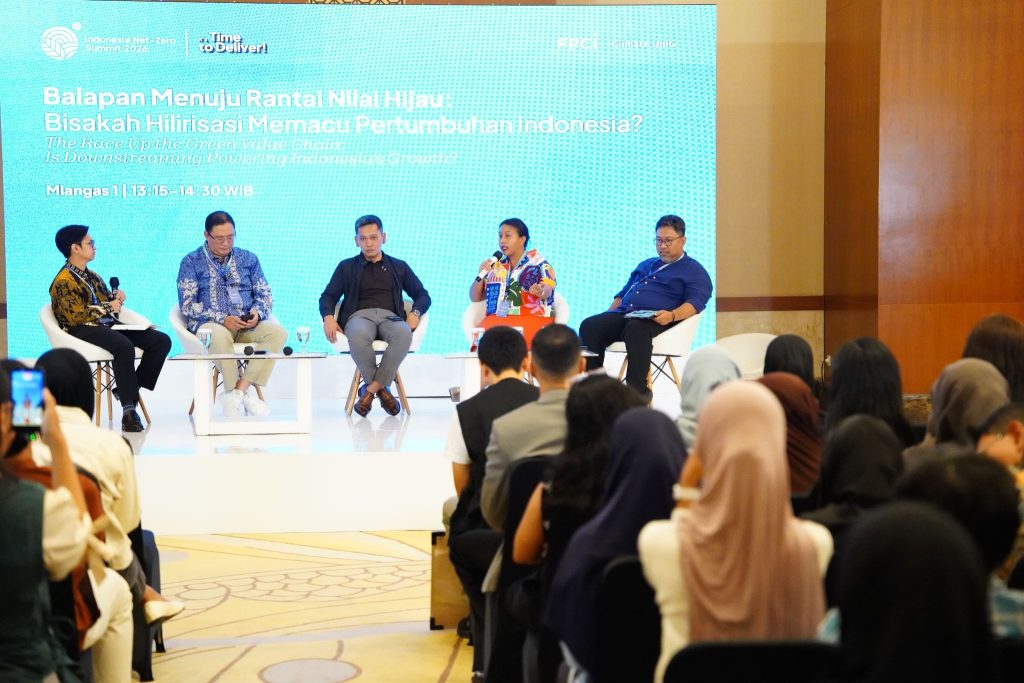
“At their core, impact investors are still finance-first. Otherwise, they would be philanthropists. But they also care about impact. So, at the very least, they expect employment to increase by a certain percentage or for there to have been no workplace accidents over the past five years.”
For that reason, she argued that the government needs to establish clear sustainability standards, not leave them to negotiations between investors and businesses. This is important because over 60% of Indonesia’s GDP depends on natural resource extraction.
Civil Society as a Check on the Ecosystem
During the INZS 2026 panel, Agung brought a different vantage point to the panel, introducing himself with a label he uses deliberately.
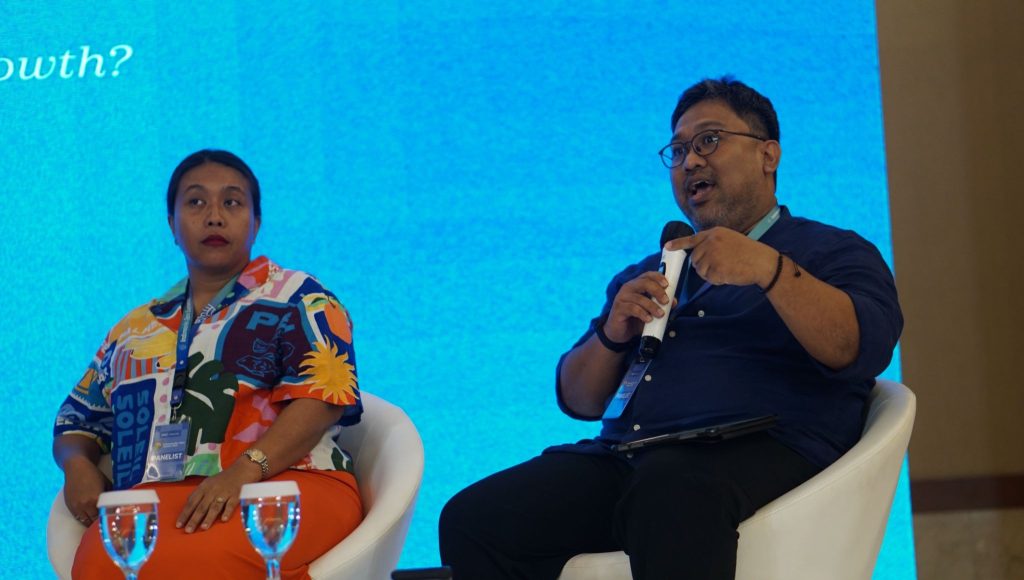
“As Pak Chatib Basri once said, democracy needs professional complainers. So that’s what I want to be, a professional complainer,” Agung said.
He backed it with a concrete example. In 2023, pressure from youth climate groups pushed Hyundai to walk away from a planned aluminum supply deal tied to a contested industrial site in North Kalimantan.
“Political pressure, social pressure from civil society as professional complainers, that’s what matters. It’s what makes sure our downstreaming trajectory stays genuinely strong.”
Saskia also emphasized that civil society organizations (CSOs) can play a vital role in advancing green investment. CSOs’ findings can serve as valuable references for investors in assessing a company’s environmental, social, and governance (ESG) commitments.
“CSOs are important because they bring to light issues that would otherwise remain unseen. They provide a whistleblowing mechanism that investors need,” she said.
According to Saskia, the more field findings disclosed by CSOs, the greater the opportunity for green investment to become genuinely accountable.
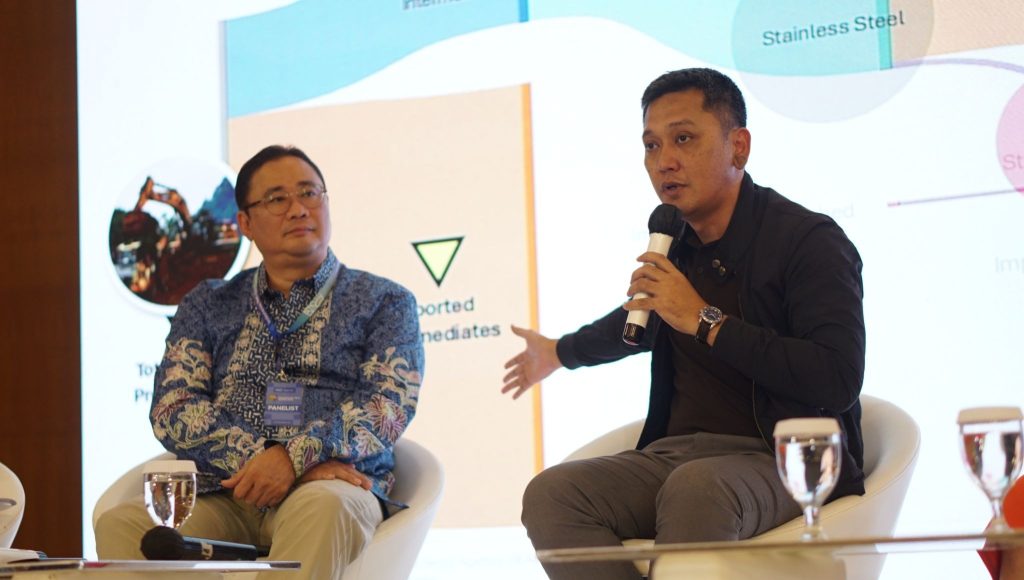
Putra added a different angle to the conversation: not just what needs to be built, but how long it realistically takes.
“Green industry is a long game. We can’t think this has to be ready by next month, or that the whole ecosystem has to be in place within a hundred days,” he said.
For him, closing that gap meant looking past headline investments like Weda Bay toward the less visible parts of the value chain.
“If we want to talk about the race up the green value chain, we have to get into what I call the boring industries,” he said.
Building a car, he pointed out, does not start with the assembly line. It starts with the factories making the bolts and components that go into it, and Indonesia still needs many more of those before it can compete further up the chain.
Taken together, the panel made clear that downstreaming is only a starting point. Moving up the green value chain takes time, deeper ecosystems, sustainability standards, and civil society scrutiny. It is not simply a decision for boardrooms and ministries, but a policy Indonesian citizens have a stake in and a right to weigh in on, whether by pushing it to align more closely with the country’s climate commitments or holding it accountable for its impact on local communities and the environment.
The Melting Pot in INZS 2026: A Room for Shared Solutions
The panel discussion explained why Indonesia needs to transition from an extractive economy. A more difficult question, however, arose afterward: How can that transition actually happen? This was the central focus of the side event of INZS 2026, “From Extraction to Innovation: Just Transition,” organized by the INTRA Institute.
The session, conducted with a Collaboration Café concept to encourage active participation, opened with a simple question: “What do you need, and what can you give, to move just transition forward?” This question was inspired by INTRA’s research, which revealed that Indonesia’s bioeconomy, encompassing forests, cocoa, coffee, seaweed, and biomaterials, remains fragmented because investors, businesses, local communities, and policymakers seldom engage in joint discussions.
Saskia opened the session by addressing the fundamental challenge of transitioning away from an extractive economy. She mentioned Norway as one of the few countries that has successfully made this transition while pointing out that many other resource-rich countries continue to face stagnant life expectancies and relatively high mortality rates.
Participants were then divided into three working groups focusing on finance, markets, and policy. Although each group held separate discussions, they reached the same conclusion: the current ecosystem is not yet prepared to support the transition.
The finance group concluded that the greatest challenge is not just limited capital, but also financing mechanisms that rely heavily on grants. Consequently, many initiatives stall at the pilot stage. The market group argued that demand must be developed through capacity building, stronger narratives, and standardization. Meanwhile, the policy group pointed out that regulations remain short-term and continue to favor large businesses.
No single solution emerged from the discussion. Yet that was precisely the message. While the earlier panel explained why Indonesia must move beyond an extractive economy, this session demonstrated that translating that ambition into concrete policies and investments is far more complex. It can only be achieved if stakeholders who have long worked in silos begin building meaningful collaboration.
What surfaced at the INZS 2026 is a call to act. Strengthening the foundation for a just transition through bioeconomy will take more than one summit, and Angin Dampak Jaya welcomes anyone ready to help build it, one collaboration at a time.

