Spotting environmental changes around a mining area is often not difficult. Visible changes like degraded mangroves, shifting habitats, declining catches, and fewer days communities can fish can be observed directly. The difficulty arises when those changes need to be expressed in numbers. What exactly should be measured? What is the benchmark? How do you determine the economic value of that change?
Some of this data may already exist for people working directly in the field. The challenge lies in understanding what the data reveals and how it relates to lost benefits, emerging losses, or shifts in the community’s economic activity.
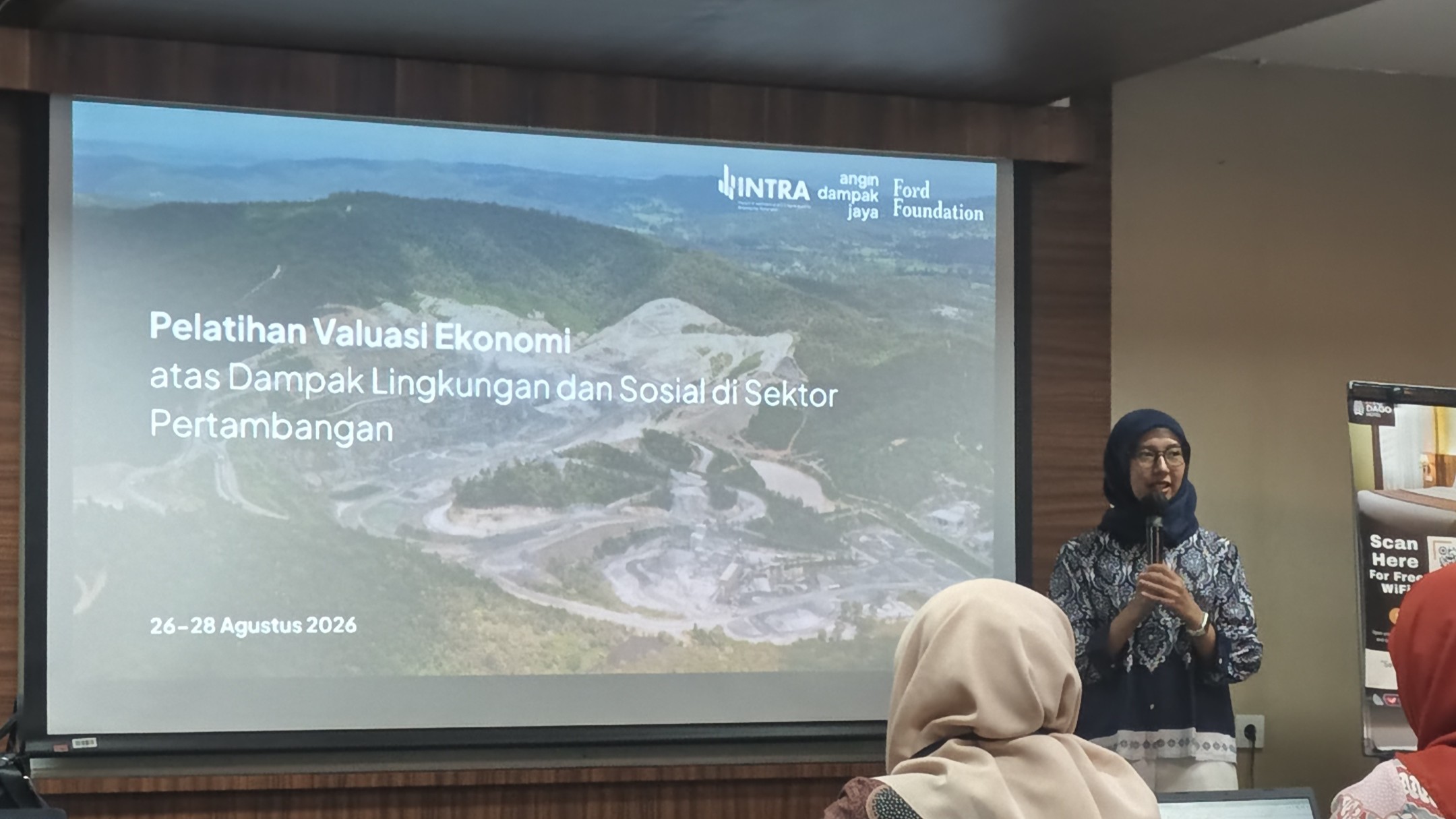
This is the question that grounded the Economic Valuation Training on Environmental and Social Impacts in the Mining Sector. The workshop was organized by INTRA Institute (knowledge generator of Angin Dampak Jaya) and the SDGs Center Universitas Padjadjaran from August 26 to 28, 2026 in Bandung.
The training brought together civil society organizations (CSOs), local governments, and academics working in mining areas in Palu, Morowali, and Central Halmahera. Over the course of three days, participants were introduced to the concept of economic valuation. This includes how changes on the ground can be connected to benefits, losses, and economic consequences.
When Environmental Losses Become Measurable
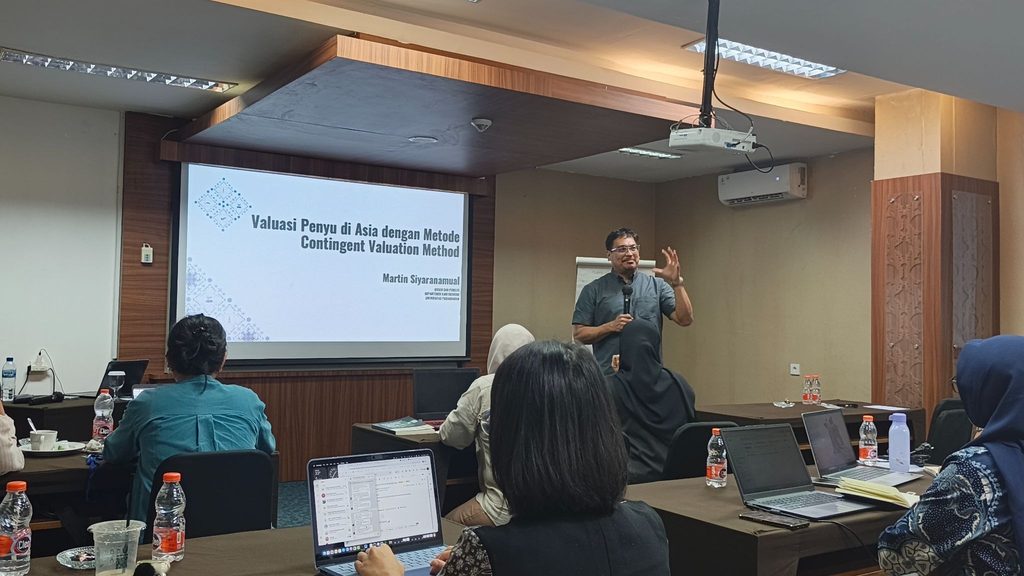
Participants were shown real cases proving that environmental losses, however small, have often already been valued elsewhere. This concept was presented by Prof. Arief Anshory Yusuf, Prof. Zuzy Anna, and Dr. Martin Siyaranamual from Padjadjaran University.
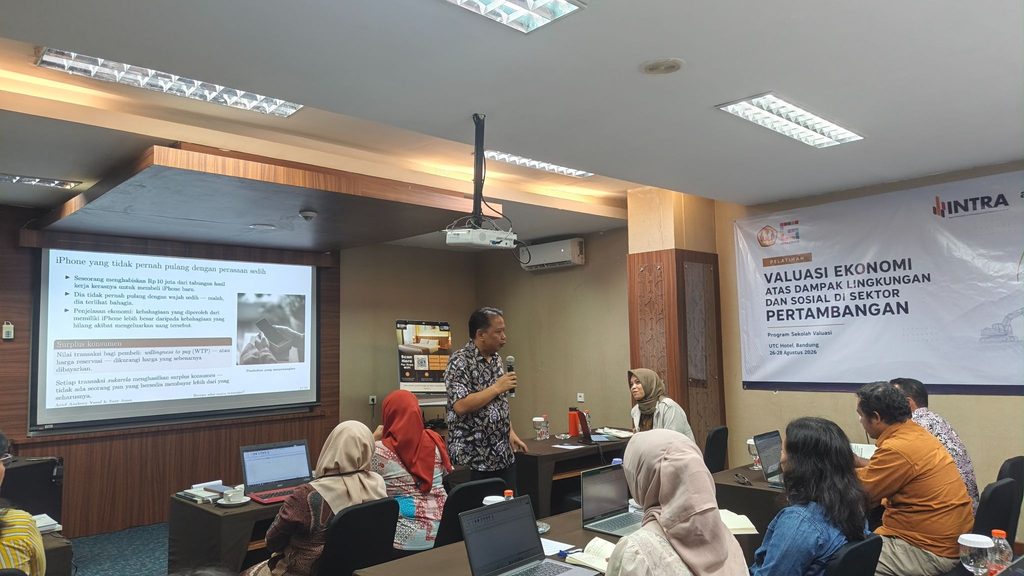
One example is the Exxon Valdez oil spill in Alaska in 1989. The disaster contaminated approximately 1,300 square kilometers of coastline and killed an estimated 23,000 birds. To figure out how much the affected communities had lost, authorities in Alaska surveyed the public and asked how much they would be willing to pay to prevent this kind of damage from happening. This is a method known as Contingent Valuation. It was the first time a survey like this had been used to estimate this kind of loss, which does not show up in any market price. In the end, the shipping company was required to pay over 1 billion US dollars in compensation.
Another example is the 2002 Prestige oil spill off the coast of Spain. The case refers to the contamination of 745 beaches, disrupting the livelihoods of fishermen, aquaculture operators, and coastal tourism businesses. Unlike in the Exxon Valdez case, the losses here were easier to calculate because relevant data already existed, such as information on the decline in catch volume and tourist numbers.
The takeaway from these two situations is straightforward. Environmental damage often feels abstract, like a dead reef or air that is no longer clean, easily treated as a loss with no real price attached. But converting that loss into an economic value provides something tangible, a number that can be used in a court of law to demand compensation.
Calculating Compensation Beyond Restoration Costs
However, calculating losses alone is not enough if the result is never used to determine compensation. The training taught participants to categorize losses into two parts: the cost of restoring the environment to its original condition and the losses incurred during the recovery process.
Example: Imagine 10 hectares of mangroves damaged by an oil spill, requiring around ten years to recover through replanting. During those ten years, fishermen can no longer catch crabs and fish as they normally would. Residents lose income from mangrove-related tourism, and the village becomes more vulnerable to flooding because the mangroves that once held back the water are now damaged.
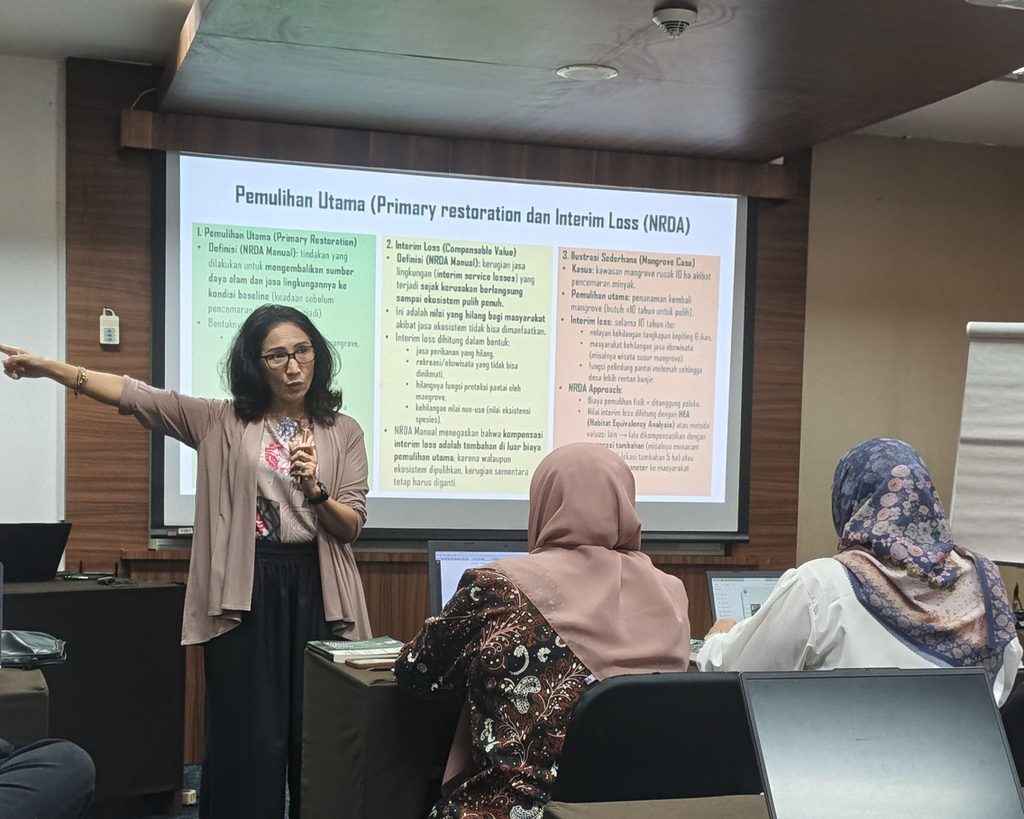
All losses incurred during this period must be calculated separately from the cost of replanting the mangroves. Moreover, they should be compensated through additional restoration efforts or monetary payments.
This approach is important for CSOs and local governments because it provides a more comprehensive way of thinking about compensation. It considers not only the cost of physical restoration, but also the losses communities experience during the restoration process.
No Damage Needed for Economic Valuation
One important point in the training is that economic valuation does not have to wait for damage to occur first. The approach used to calculate costs and benefits can be applied before a mining or infrastructure project begins. This allows all parties to consider the trade-offs before the project impacts communities.
For CSOs accustomed to collecting field data on environmental conditions, catch volumes, or community health, the training showed that this data is sufficient to begin answering important questions. For example, what are the economic losses from a lost livelihood? Who bears the brunt of that loss? How much would it cost to restore the damaged environment?
Answering these kinds of questions is one of the focus areas of the INTRA Institute. Through the training, INTRA provided a space for CSOs, local governments, and academics to reexamine their existing data and explore what can be measured and how economic valuation can be applied to cases in Palu, Morowali, and Central Halmahera.
Learn more about how economic valuation can become a valuable tool in advocating for your protection and conservation goals.