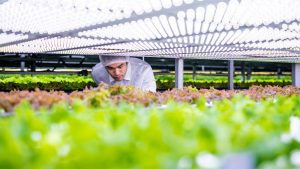
The growth of the Bioeconomy is increasingly becoming part of of Indonesia’s economic strategy focus. By definition, a bioeconomy is an economic system that produces food, energy, and services using biological resources, such as plants, animals, biomass, and organic waste, which are more sustainable and socially responsible compared to other resources. The bioeconomy sector includes various industries, from agroforestry to aquaculture. Considering the vast biodiversity, Indonesia is ideally positioned as a strategic hub for these bio-based industries, making great potential for the country’s bioeconomic development.

The Indonesian government has recognized this opportunity, formally positioning bioeconomy as a pillar of national development in the RPJPN 2025-2045. This decision anchors it within the country’s long-term bioeconomy action plan, recognizing that “nature-based innovations could contribute up to 37% of the emissions reductions needed to meet its climate targets.” This signals that the bioeconomy is not only an environmental agenda but also a long-term national economic priority supported by policy and public investment.
In response to this mission, Yayasan Angin Dampak Jaya (YADJ, also known as ANGIN Advisory) has launched an evidence-based insight into the bioeconomy landscape in Indonesia through the report Bioeconomy in Indonesia: Private Investor Appetite and Preferences by INTRA (Impact Investment and Entrepreneurship Knowledge Generator) to better understand the potential of the bioeconomy sector for entrepreneurs.
Understanding Investor Appetite for Indonesia’s Bioeconomy
Through INTRA, YADJ conducted applied market intelligence to bridge gaps between capital, policy, and enterprise in figuring out one thing: what is the investor appetite for the bioeconomy in Indonesia like, and what is its significance for entrepreneurs?
Investor appetite refers to how willing and interested investors are in putting capital into an industrial sector. The investor appetite considers ecosystem players’ evaluation of the sector’s risk, return potential, scalability, and policy stability. Aligning with Indonesia’s national development plan of RPJPN 2025-2045, the investor appetite for the bioeconomy sector in Indonesia is evidently growing and substantial.
Although the term “bioeconomy” is relatively new in private sector discourse; the report looks at future appetite based on current evidence, and it shows that investors are already allocating significant capital to related industries. By 2024, the five subsectors with the highest funding value in Indonesia are:
- Agriculture (USD 10.43 billion)
- Farming (USD 10.27 billion)
- AgTech (USD 9.92 billion)
- Food and Beverage (USD 0.50 billion)
- Biotechnology (USD 0.48 billion)

The investors in the bioeconomy ecosystem vary in terms of how they view their capital. Although investors are actively funding related bio-sectors, the investors do not call themselves players of the bioecosystem. Instead, they frame their investment strategies around sustainable materials, agrifood innovation, and circular economy solutions, which naturally overlap with bioeconomy sectors. This domain-based approach indicates that investor appetite is leaning more towards commercially viable solutions rather than sector labeling.
The way investors view their contribution also differs between capital types. In Asian family offices, philanthropic initiatives are separated from their core investment activities, making them more risk-averse than large institutional investors. Those large institutions, with venture capital and private equity, approach their capital strategy using holistic sustainability assessment tools to evaluate qualitative factors and local impact, often focusing on investing in bioeconomy sectors without using the terminology.
This pattern of capital flow and high investment indicates investor appetite for Indonesia’s bioeconomy sector is active, diversified, and commercially grounded. This shows that the capital for bioeconomy sectors does not flow on abstract sustainability narratives, but is instead caused by the structural growth fundamentals and tech-enabled business models in Indonesia’s expanding middle class and digital adoption; all of which are continuously developed and fostered by Indonesia’s economic development plan of 2025-2045.
Bio-Entrepreneurs’ Potential & Indonesia’s Green Investment Landscape
According to investor profiles and the portfolios database in 2025, several large investors are active in portfolios aligned with bioeconomy initiatives, reflecting diverse investor profiles that include venture capital funds, corporate venture arms, and family offices. Among the investors, the most engaged are the mainstream venture capital players that support scalable businesses in the sectors of agriculture, food systems, and green technology. The investors are:
- 500 Global (11 companies)
- Antler (11 companies)
- 144 Ventures (8 companies)
- East Ventures (7 companies)
- Alpha JWC Ventured (7 companies)
The leading firms consistently guide bioeconomically aligned ventures by providing both capital and market validation. Moreover, their continued participation signals that investmentsare based on the business’s scalability and sector impact. The government facilitates this investment approach by reducing financial and operational risks for bio-entrepreneurs (such as VAT exemptions for agricultural and fisheries inputs and import duty relief for conservation-related goods) that can directly improve venture cash flow and project feasibility. These measures improve risk-return profiles that are viewed and assessed as the capital allocation determining factor.
For instance, a UK-based investment firm managing approximately US$15-20 billion in assets invested in an herbal medication company in Indonesia. This investment demonstrates how companies aligned with bioeconomy sector can attract large-scale international capital with strong fundamentals and local sourcing. Essentially, the benefit of bioeconomy in Indonesia’s landscape is to align economic growth with environmental sustainability, enabling market expansion beyond national borders, and long-term cost efficiency through resource optimization.
“Bioeconomy investment in Indonesia is to be positioned at the intersection of three core elements: Indonesia’s unique strengths and resources, areas of private investors’ existing interest, and a supportive policy that encourages private capital investment.”
For bio-entrepreneurs and MSMEs, it is clearly implied that:
- The bioeconomy is already attracting billions in private capital
- Agriculture, AgriTech, food systems, and circular solutions are bioeconomy sectors that are most invested in, according by trend evidence
- International investors are open to Indonesian bioeconomy ventures when business models are scalable and commercially viable
- Government policy and public co-investment are strengthening the investment environment
Subsequently, this means the bioeconomy is no longer just a sustainability narrative. It is a concrete business opportunity for those building in green, regenerative, and nature-based sectors.
More About Investor Appetite on Indonesia’s Bioeconomy Development

To know more about the investor appetite in Indonesia’s bioeconomy sectors, read our full report titled Bioeconomy in Indonesia: Private Investor Appetite and Preferences and dive deep into Indonesia’s investment market condition.